up:: 099 MOC Anotações // 010 MOC Marxism // 027 MOC Category Theory
Preliminary remarks
Motivation: common conceptual frame to deal with political economy and political organization (!)
References:
- Yuan Yao (“Dennis”), “Phenomenology of Value” (2016) crisiscritique.org/storage/app/media/2016-11-16/yuan-yao.pdf
- Primer on Political Phenomenology (Yao and Tupinambá, 2021) space.ideaofcommunism.com/uploads/6d94b52cd66ea6164f0f643e3d875325.pdf
“Theory of social worlds”, from CSO (Common Space for Organizations/Espaço Comum de Organizações).
Modeling
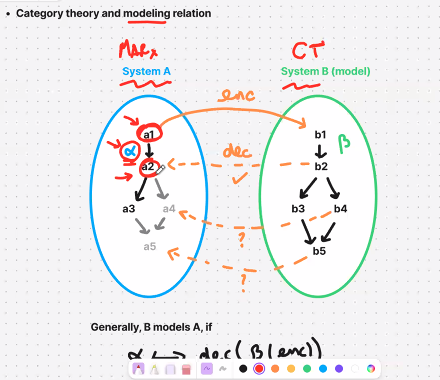
System
for some
The advantage that can be gained is that elements in
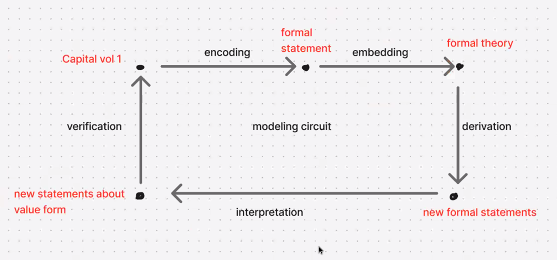
Embedding yields an allegory (mathematical concept [!]). The importance of this is to prove ontological statements, not merely in the “representational” space.
A convergence of theories
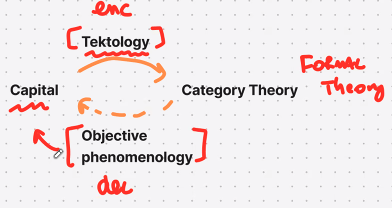
- Category Theory
- Tektology (Bogdanov): general theory of natural/social/political organization theories
- Objective Phenomenology (Badiou): “Reason of Worlds”, a theory of phenomena/appearances
Immanent critique: not for seeing from the outside, but from seeing more from the inside, seeing inside more thoroughly.
Interpreting “objective phenomenology”: analysing some object not by “looking from the outside”, but by HOW IT APPEARS to OTHER PARTS OF the system.
E.g.: money can only see what is equal to it in value and what isn’t. Capital sees things as what can valorize itself and what can’t.
E.g. 2: the labor process can be seen differently:
- A worker sees things changing and being created
- Money sees value coming in and coming out greater
- capital sees constant and variable capital combining into commodities
Fetichism and light example: to understand why light appears with different wavelengths is to understand why different retinas see them differently. Using a microscope allows for a more thorough analysis of the phenomenon of light, but not on why it differently appears to us! A fetichistic understanding is to try to understand this difference within the very phenomenon (?).
Artificial restriction of evaluation space: fetichism goes away when it is seen from outside its usual restricting/mistifying scope; a flattening of perspectives.
A natural question is: when do we know we’re having a limited, “fetichistic” point of view? The general answer is: when you are seeking to “leave no stone unturned”.
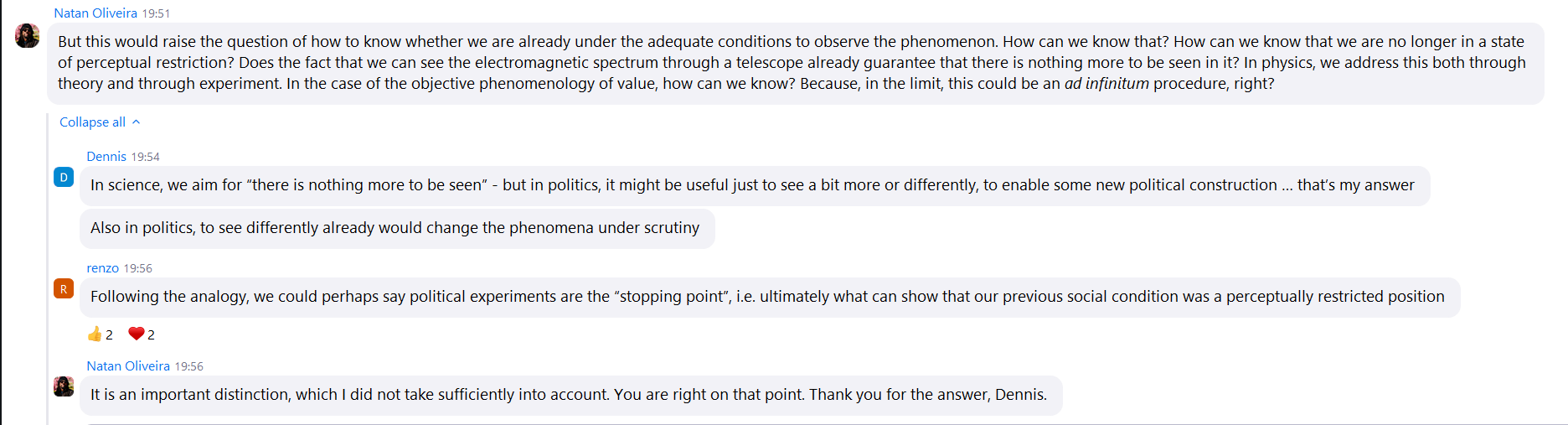
Evaluating whether two commodities are equivalent or not:
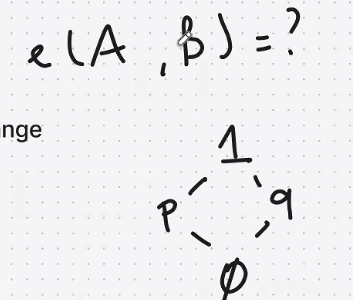
So they start beyond assuming that commodities are all comparable, and retrieving results that are valid for equivalent commodities from this more general statement.
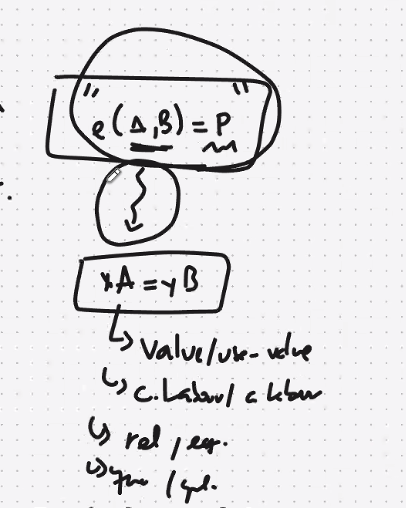
Mentions of categorical terms:
- Kernel
- Stability
- Limit (Category)
- Kernel Stability
Commodities are produced such that they are comparable to other things (commodities)! A “defective” product is one that is not like the other products within a same production process.
A use value of something is the “intersection” of its use and the use value kernel (?). So the “use” of a thing is distinguished from its “use value”.
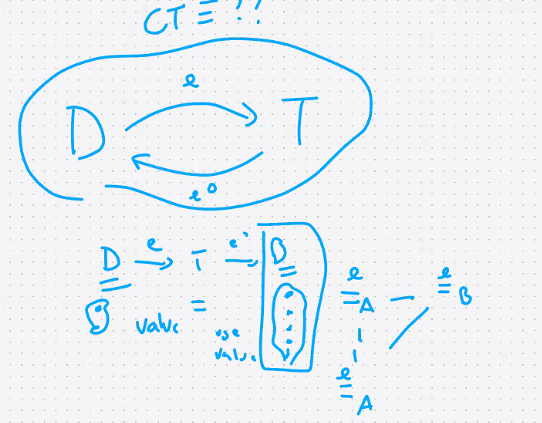
Evaluating
For capital to be a consistent value relation, it either
- Breaks its own logic, and only sees equivalence
- Breaks equivalence somehow
In this sense, it is “needed” to have different degrees of evaluation between commodities, since Ciclo D─M─D’ produces something that is not equivalent to what was spent: transitivity is broken, at least formally!
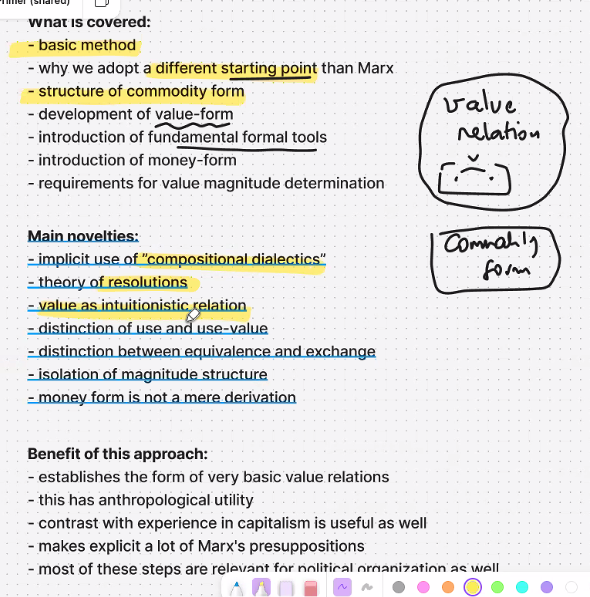
Value is an intuitionistic relation!!!