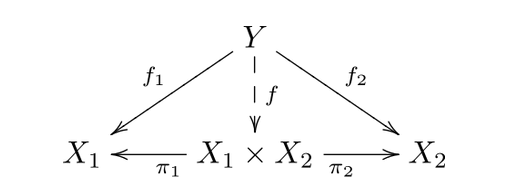
If there is some other object which has morphisms to the individual objects , then there is a unique morphism from it to the product . This makes it so that any object which satisfies this property is isomorphic to each other, i.e. there is only one product up to isomorphism (if there is any product at all in ).
Cartesian products in Set are categorical products
Given two sets , denote their cartesian product as , and let
be the respective projection maps. Let some other set have functions . Then we will always be able to factor through the product , since we can construct through
Since it is explicitly constructed through , then it is unique (given these functions and ).
Disjoint unions of sets are categorical coproducts
The disjoint union of and is the set
the union of their elements, discriminated by their sets of origin.
Given sets and their disjoint union , there exist natural inclusion maps from each of these sets onto their coproduct
i.e. it just labels each element according to its original set.
Note that, for any set such that , a function can be constructed as
That is, is defined as follows:
I.e. we just check ‘s label, and use its respective .
Categorical (co)products in posets are meets (joins)
Let be the poset category with morphisms being its preorder. Then an object which is a product of given means that
I.e. is a lower bound of and .
Given another object that also has morphisms to and — i.e. is also a lower bound of them —, then is their product when there is a morphism from to . That is, must be the greatest lower bound of and , i.e. their meet .
Conversely for the coproduct: is the least upper bound of and , i.e. their join.
References
MAC LANE, Saunders, Categories for the Working Mathematician, New York, NY: Springer New York, 1978.