up:: 099 MOC Anotações
Recap
(MELT — Monetary Expression of Labor Time)
The “language of commodities” contains things like
Having the money commodity
But capital’s language is more complex than that of money. For instance, “this amount of money can beget this future amount of money”.
Mention of “Ulrich Krause”, “Abstract labor and money”: linear algebra. Usually, marxist formalizations are good up until surplus value and capital…
Dealing with objective phenomenology mean “only adding structures that can be seen by existing structures”. For instance, having just money and commodities doesn’t allow (by itself) the distinction of “means of production” and/or “labor power” — as far as money is concerned, all things are equally commodities.
Stable commodity spaces
Locales
What effectively happens in this space has to have a “witness”, has to have been “observed”.
We can zoom in on our observation space, and for overlapping regions of observation, these observations must be compatible! They must talk about the same event.
So if two observations agree over all restrictions, then they are the same observation. This is a separated Presheaf (??).
Example:
Other example: two different observers may disagree on some observation (one sees sunny, other sees raining), but there can be other context that distinguishes them — e.g. place!
That is, different stable commodity spaces — with different money commodities
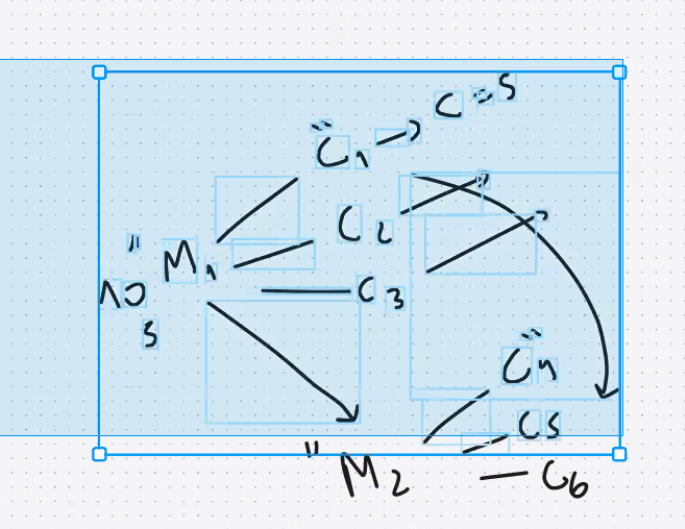
Sheaves can talk about local statements that are consistent among themselves! That is, all local contexts can be glued to yield a global one (which is compatible with all those local ones).
Frames and locales are dual to each other: all topological spaces
Three ways of thinking about politics (at this discussion)
- “Conservative” politics: integrating new stuff into existent (circulation) spaces
- “Reactionary” politics: using new stuff to build new relations on existent (commodity) spaces
- ???
Capital
For commodities, we have some evaluation
We must show that adding this new capital structure to the formerly constructed formalism is consistent with it. This addition is, so to say, “arbitrary” as far as the former construction is concerned, and thus is a political statement — hence, political economy!
It arises as a form to “solve the contradiction” that is “having a depleting circulation”!
Capital induces a layer divergence: exploiting different layers (e.g. property layer, commodity layer, etc) to allow for value divergences.
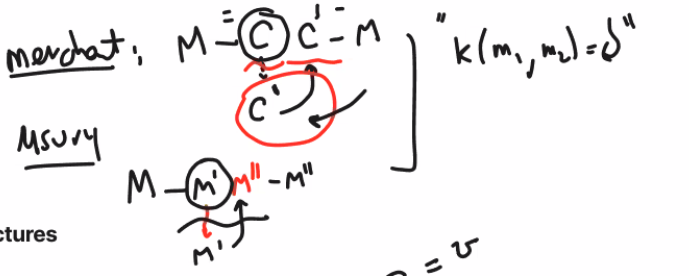
- Merchant capital:
which gets “relabeled” — “retabulated” — to , then . Both processes are value equivalent, but there’s a break inbetween - Usury capital:
will be “retabulated” through some other dimension/layer
Resolutions: All objects are described/valued by some predicate
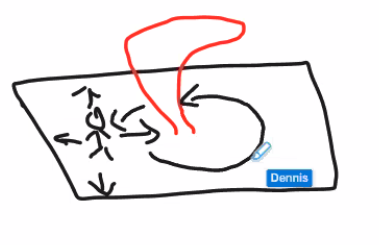
Capital (yielding more value from “outside” this space) vs arbitrage (redistribution of value within the space). Fetishism then consists on only seeing the whole behavior from “what can be seen from your perspective”, instead of describing this behavior in its own terms; it’s like seeing only the sections of some cone (slicing through “your space”) and talking about it as consisting only of sections, versus inferring it is itself a cone from the seen sections.
Monoidal categories
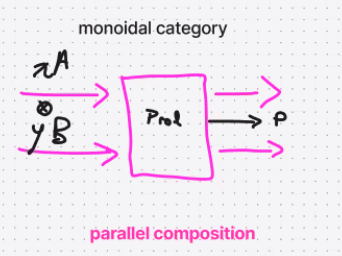
Monoidal Category: categories with parallel composition (some parallel composition
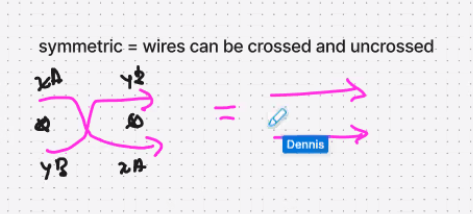
Symmetric Monoidal Category: when the parallel composition is commutative.
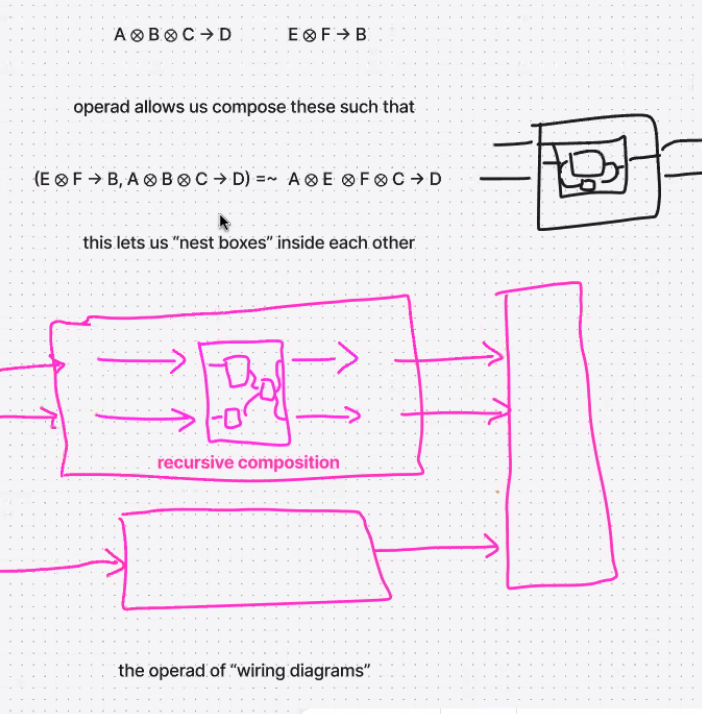
Working with operads allows for more complex processes — this is where (capitalist) production is!!
Consumption, production and labor
Consumption: some thing
Production: Objects are consumed in such a way that produces some other thing(s).
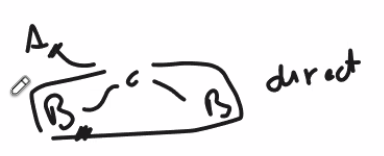
Directed consumption: one of the consumed objects can be told apart from the others.
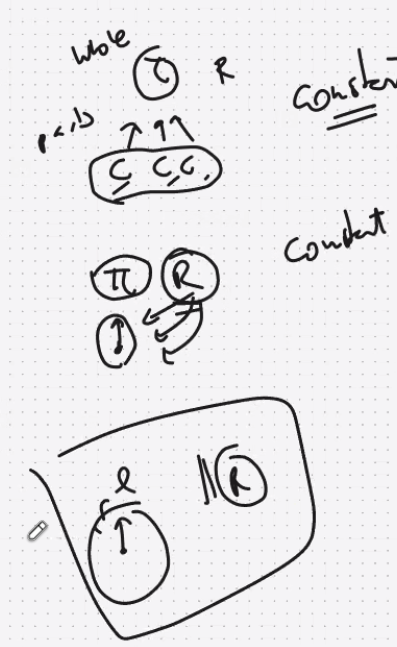
Labor is some invariance of production: it is something that is always present in different processes.
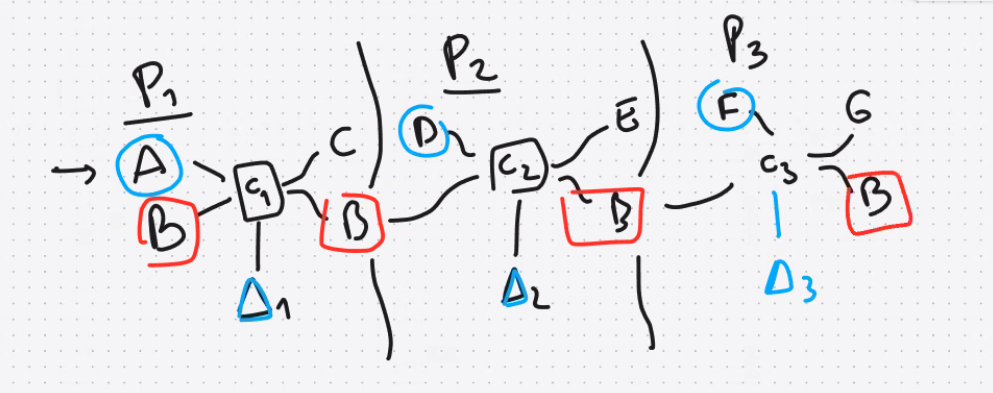
Production with labor is directed, and can enchain, through adaptation of resolutions.
Discussion of Lukács and teleological positioning
So planning isn’t the best way to distinguish “human labor”.
Michael Levin — “scale theory of cognition”, changing the scale of the “purpose space” for needed solutions (?). That would be a measure of “intelligence”.
“Econophysics” book, talks about bee colonies and their planning stuff.
Commodity production point of view
We need processes in
Given some commodity
a) produced from some previous commodity production
b) it was commodified (it entered
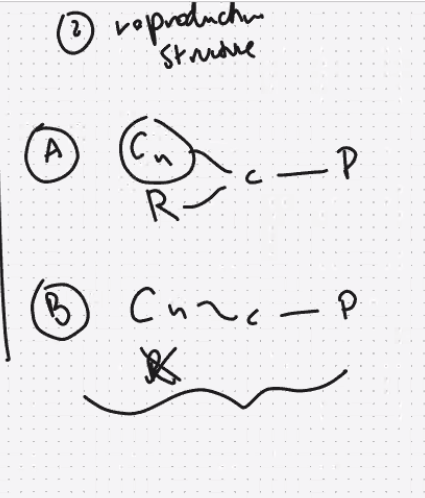
Reproduction structure (2):
a) Requires reproduction products to consume
b) Does not require reproduction products to consume
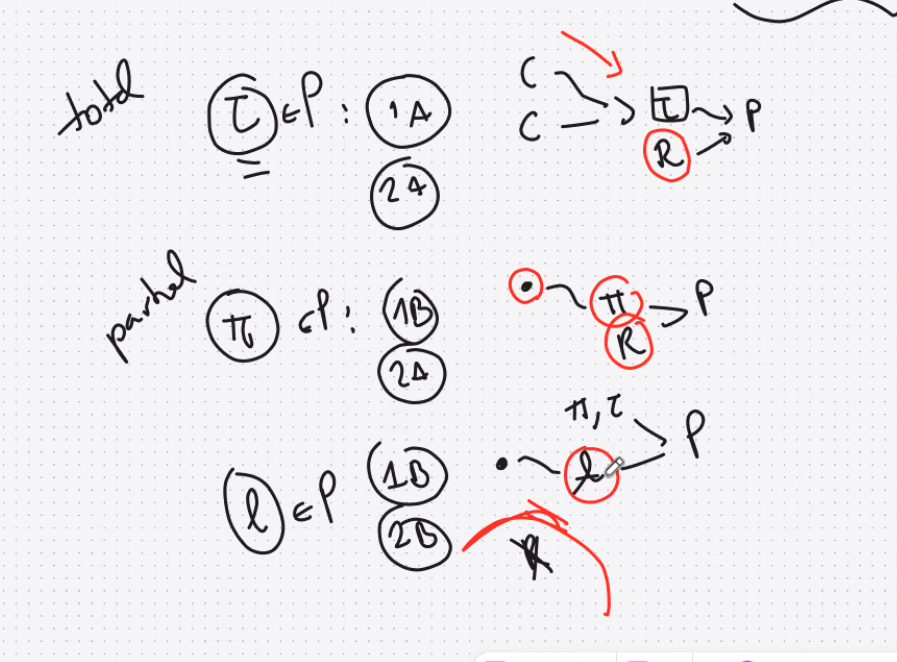
Total component of
Partial component of
Labor