up:: 0x51a Revisão de Literatura Rebound-Backfire Effect
Brookes, dez. 2000
“If there are savings in the cost of direct energy services or of goods and services that call for the consumption of energy in their production, the income released must find an outlet. In modern industrial societies it is likely to be on goods and services that require energy in their production if not also in their use.” (Brookes, 1990, p. 321, grifo meu)
(I.e. naturaliza a necessidade de se empregar recursos poupados!)
“Much of the apparent energy efficiency response was more in the nature of an economic phenomenon than deliberate planned action. Higher energy prices have the effect of pricing some of the more energy-dependent goods and services out of the market.” (ibid., p. 323, grifo meu)
Exemplo de Brookes (citando The Economist): Primeira Crise Mundial do Petróleo (1973) fez com que 4% da “capital plant” americana fosse à bancarrota — justamente indústrias mais dependentes de energia/petróleo. Dessa forma, os 96% restantes aparecem como “mais eficientes energeticamente” em média, mesmo que nenhum choque positivo de eficiência tenha ocorrido! (p. 323)
Hanley et al., 2009
Simulação de Efeito Rebound/Efeito Backfire na economia escocesa, comparada com “rest of UK (ROUK)” e “rest of world (ROW)”, através de modelos computáveis de equilíbrio geral (CGE).
Descrição
“It is conventional to make a distinction between the direct and indirect effects of an improvement in energy efficiency on energy use. The direct effect is the impact in the activity to which the efficiency improvement applies. The indirect effects are the other, system-wide impacts associated with the changes in consumption and production of other goods and services that causally accompany the efficiency change.” (Hanley et al., 2009, p. 694, grifo meu)
A dificuldade é de estimar tais efeitos indiretos, justamente pela interconexão da indústria como um todo, tanto intranacional quanto internacional. Para isso, Hanley et al. utilizam modelos de equilíbrio geral (computáveis), pois “they allow the system-wide effects of the energy efficiency improvement to be captured.” (ibid). Empregam o modelo AMOSENVI.
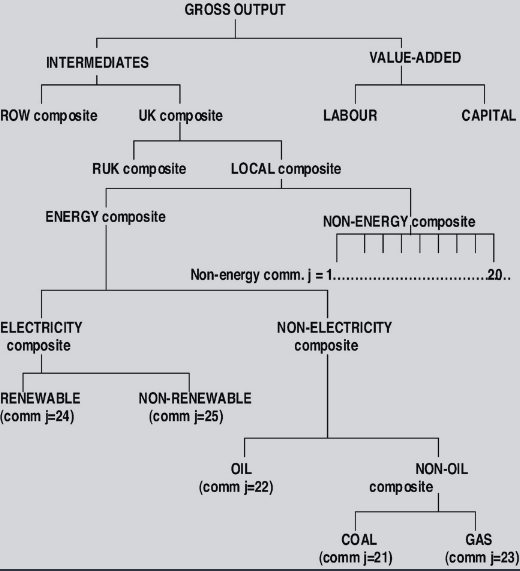
(p. 695)
A divisão que os autores fazem é de subdividir o PIB escocês em:
- ROW
- UK
- RUK
- Local (Escócia)
- Não-energia
- Energia
- Eletricidade
- Renovável
- Não-renovável
- Não-eletricidade
- Petróleo
- Não-petróleo
- Carvão
- Gás
- Eletricidade
“This separation of different types of energy and non-energy inputs in the intermediates block is in line with the general KLEM (capital-labour-energy-materials) approach that is most commonly adopted in the energy/environmental CGE literature.” (p. 696, grifo meu)
Simulações utilizam Função de Leontief e Função de Utilidade CES (produção).
Simulações: choques exógenos de eficiência energética (5%)
“The stimulus to energy efficiency is a beneficial [normative statement!] supply-side shock that we would expect to lower prices, improve competitiveness and stimulate output.” (p. 698)
Resultados
Tal choque de eficiência energética pode até gerar queda (com efeito rebound) no curto/médio prazos em consumo energético, mas induzem efeito backfire no longo prazo.
“While energy efficiency does initially lower the demand for energy, the increase in competitiveness is concentrated in the most energy-intensive sectors of the economy. Where these sectors are also exporters, this generates a large boost to that sector and to the economy as a whole.” (p. 699, grifo meu)
Setores que são mais intensivos em energia são justamente os que mais se beneficiariam de um choque de eficiência, pois poderiam usar menos energia para mesmo produto. O “efeito produto” que tal choque induz sobrepuja o “direct negative efficiency effect” desta queda de insumos necessários.
Isso, por sua vez, afeta o resto da economia no longo prazo, induzindo efeitos system-wide num processo de retroalimentação.1
“…another energy indicator given in Section 3 is the share of electricity generated from renewable sources. Fig. 4 shows that this falls from the outset [of the efficiency shock] due to the fact that the more energy-intensive non-renewable electricity sector receives a greater stimulus as a result of the increase in energy efficiency. An improvement in energy efficiency therefore causes a perverse change in a key sustainability indicator.” (p. 700, grifo meu)
Conclusões
“In our central case, we find that an improvement in energy efficiency results in an initial fall in energy consumption, but this is eventually reversed: positive output and substitution effects associated with lower effective energy prices ultimately outweigh the direct efficiency effect. There is a significant rebound effect immediately that gradually increases through time, eventually resulting in backfire in terms of electricity consumption: for electricity production, however, backfire is immediately apparent.” (p. 705, grifo meu)
Sobre propostas de mitigação disso: mecanismos de mercado, claro.
“The results presented here imply that[,] in order to ensure that increased energy efficency generates improvements in local sustainability indicators[,] it is necessary to counteract the positive competitiveness effects that occur due to the fall in the cost of production in energy-intensive sectors. This could be achieved by the introduction of a (higher) tax on energy use or a carbon tax.” (p. 705, grifo meu)
Gillingham et al., 2015
“In particular, we distinguish between the rebound effect from a costless exogenous energy efficiency improvement—what we will refer to here as a zero-cost breakthrough—and the rebound effect from an actual (typically costly) energy efficiency policy—what we will refer to here as a policy-induced improvement.” (Gillingham; Rapson; Wagner, 2015, p. 1, grifo meu)
Os autores destacam que o approach mais comum na literatura para estimar o efeito rebound “is to empirically estimate fuel-price or operating-cost elasticities of demand” (p. 2, grifo meu). Destacam, porém, que os efeitos distinguidos acima são conflados neste processo.
Diferenciam-se dois tipos de “choques de eficiência”:
- “Zero-cost breakthrough”: “in which an innovation allows a product (e.g., an appliance) manufacturer to increase energy efficiency costlessly while holding all other attributes of the product the same.” (Gillingham et al., 2016, p. 3, grifo meu). Ou seja, efeitos rebound consequentes (de consumidores e de mercado) serão “efeitos puros”.
- “Policy-induced improvement”: “whereby a policy requires manufacturers to improve the energy efficiency of a particular product” (Gillingham et al., 2016, p. 3) — “may be costly, potentially raising the price of the product” (Perda de Peso Morto), e mesmo a qualidade e quantidade do produto, trazendo toda sorte de efeitos micro- e macroeconômicos.
Canais microeconômicos do efeito rebound
“When energy efficiency improves, the price of energy services changes. Substitution and income effects arise, which influence consumers’ consumption of the energy services and, ultimately, energy use.” (Gillingham; Rapson; Wagner, 2015, p. 4)