up:: 099 MOC Anotações // 20260302 Anotações Categorias e Capital (Espaço Comum de Organizações)
Dialectics
- “Objects” need be situated (contingent). I.e. they can be changed
- Contradiction between these objects and their surroundings.
- Negation and change of the objects’ situation
Level theory
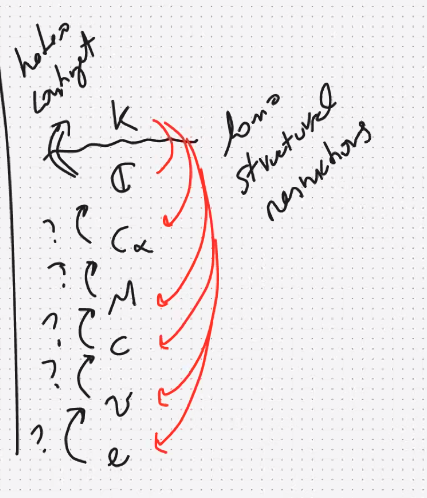
We can see the dialectical aspects better when we see this asymmetry of these aspects of the theory: “upper” levels are heterogeneous and contingent to the lower ones, but the “lower” ones are homogeneous and are related to structural restrictions as far as the upper ones are concerned.
E.g. when capital
Mystification/Fetishism through level theory
Mystification:
Fetishism: Processes which happen at a new level can’t explain their coming-of-being from a lower level merely through the new-level processes.
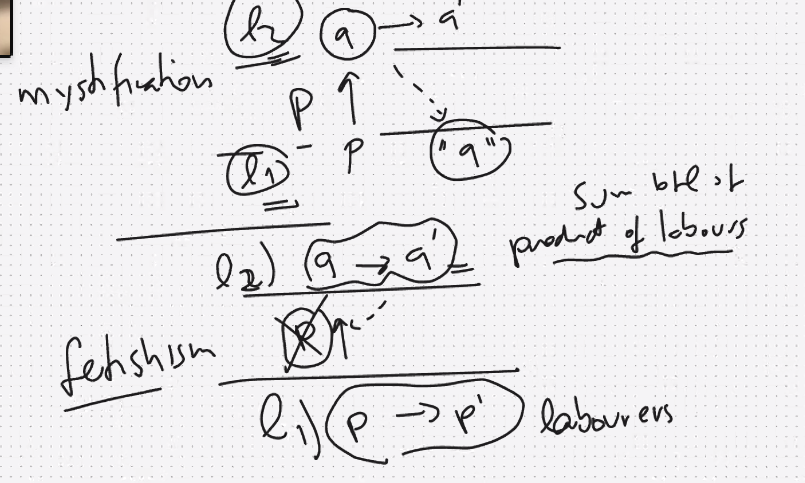
Commodity fetishism as per Marx: “the relation of the producers to the sum total of their own labour is presented to them as a social relation, existing not between themselves, but between the products of their labour”.
That is, producers
Capital levels
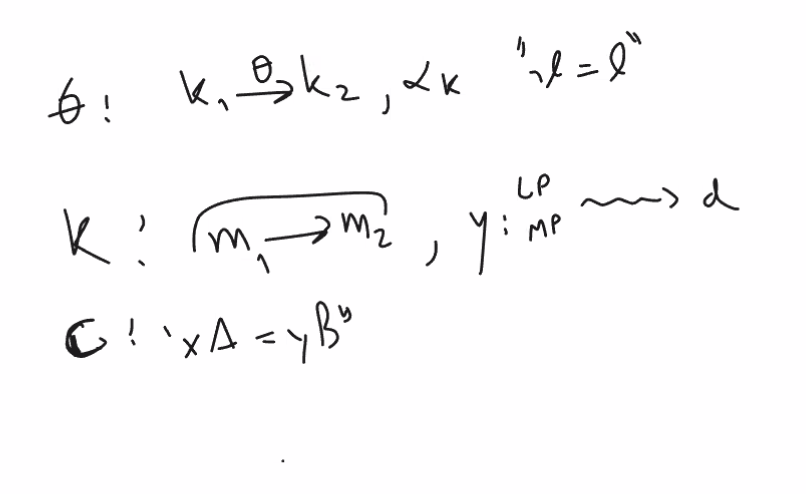
Lowest level is the commodity level: just commodity circulation and exchanges.
A level above would be money begets money: this amount of money
A level beyond would be total social capital accumulation: this capital
Law of capital accumulation
The form of immiseration (misery) of the working class is a projection of the organic composition of total social capital.
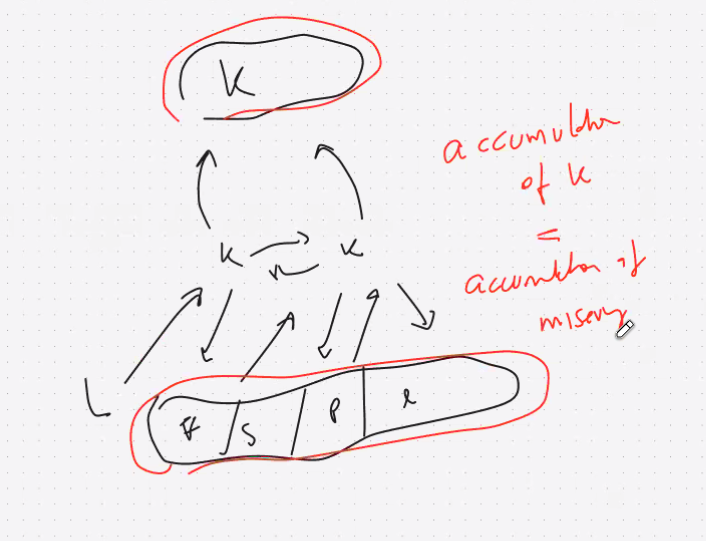
The trajectory of the working class between its possible states — floating, latent, stagnant, pauperized — yields more information about the total social capital than about individual capitals.
This, in fact, is a definition of domination: the power of a totality is imposed upon a whole level/class. That is, the aggregate effect of actions of dominating individuals imposes itself upon the dominated individuals’ lives.
Bi-Heyting Algebras
Accounting for property and affinity, aside from value.
A presheaf topos for value already yields a bi-Heyting algebra for free (thm). There are now Heyting-valued functions
for evaluation, property and affinity.